

Why “fear of AI” covers many very different fears.
Two people can say the same thing — “AI scares me” — and mean something entirely different.
One may notice that commissions are disappearing because part of her work can now be automated. Another may think about surveillance, manipulated images or autonomous weapons. A third worries about the power of the companies developing and providing the most capable AI systems. And someone else wonders whether we may eventually build technologies whose behaviour we can no longer predict well enough.
We use the same umbrella term for all of these concerns: fear of AI.
That is imprecise language and makes sensible discussion more difficult. Behind these fears lie different problems and causes – and therefore different possible responses.
The fear of what the machine can do
One part of the concern begins with actual capabilities.
AI can now do things that only a few years ago were considerably more difficult or seemed largely reserved for humans. It can generate convincing text, images and voices, analyse enormous amounts of data, write software and support decision-making.
Being able to imitate a human voice convincingly is, in itself, simply a technical capability. It can support people who have lost their voice – or create new opportunities for fraud and deception. The US Federal Trade Commission describes precisely these two sides of the technology. Source: FTC
The capability alone does not determine what follows from it socially.
But that does not mean the technology itself is completely neutral.
How neutral can a tool be?
A common reassurance is:
“AI is only a tool. What matters is what people do with it.”
There is some truth in that. People, companies and governments decide which systems are developed, what they are used for, who gets access and which business models grow around them.
Technical systems do not emerge in a vacuum. They are developed with particular goals, data, feedback and constraints. Those choices influence which behaviours are encouraged and which consequences become more likely.
A recommendation system optimised to maximise attention or interaction creates different incentives from one in which reliability or safety is the priority.
With language models, too, changes to post-training and feedback signals can visibly alter behaviour. In 2025, OpenAI itself described how changes to training signals contributed to a version of GPT-4o becoming excessively agreeable with users. Source: OpenAI
People determine goals and use. But the properties of a system influence what consequences follow.
So neither “the AI is to blame” nor “the AI cannot be blamed” is enough.
Which problems arise from human decisions – and which are amplified by the properties of the systems themselves?
The fear of who shapes the machine
Many people therefore worry not only about what an AI can do, but also about who decides how it should behave.
Which data is used? Which answers are judged helpful or problematic? What rules is the system given? Which behaviours are later encouraged or suppressed?
A single chief executive does not personally write every answer an AI gives. But between the original training data and the answer that finally appears on our screen lie numerous human decisions: about training methods, post-training, safety rules, higher-level behavioural instructions and product design.
How visible such instructions can become was demonstrated particularly clearly by Grok in 2025.
In May, the Grok bot on X began repeatedly inserting claims about an alleged “white genocide” in South Africa, even when users had asked about completely unrelated topics. xAI later said that an unauthorised change to the higher-level behavioural instructions – the so-called system prompt – had instructed Grok to address a particular political topic. After the incident, xAI announced additional controls and began documenting its system prompts publicly. Source: Associated Press
Less than two months later, in July 2025, the Grok account on X spread antisemitic content and praised Adolf Hitler. xAI removed problematic posts, apologised and subsequently changed instructions governing the system’s behaviour again. Source: TechCrunch
That such instructions are genuinely part of the product can now be checked directly: xAI publishes various system prompts for Grok and individual product features in a public repository and updates them over time. Source: xAI
Trust therefore extends beyond the technology to those who decide how it is shaped.
A question about values quickly becomes a question about power.
The fear of unequal power
Who actually controls access to this technology?
At the frontier of development, computing power, specialised chips, billion-dollar budgets and expertise have become decisive resources.
The Stanford AI Index 2026 illustrates how strongly industry shapes development: more than 90 per cent of the “notable frontier models” recorded for 2025 came from industry. At the same time, investment and spending on computing and infrastructure have reached new scales. Source: Stanford AI Index 2026
The infrastructure beneath these systems is not evenly distributed either. The European Commission describes the limited and geographically concentrated availability of computing capacity within the EU as a strategic problem and explicitly points to dependence on non-European cloud and AI computing providers. Source: European Commission
Open models can broaden access. But being able to download a model is not the same as having the data centres, chips and billion-dollar budgets needed to train the next generation of systems.
That gives some actors capabilities that others do not possess: they can analyse vast amounts of human behaviour and influence which information people see.
The underlying concern is the unequal technological power held by a small number of actors.
With military applications of AI and autonomous weapon systems, another question becomes particularly important: how much control do humans retain over the use of force?
The International Committee of the Red Cross defines autonomous weapon systems as systems that, once activated, can select targets and apply force without further human intervention. One distinction matters here: autonomous weapon systems do not necessarily have to rely on AI. The ICRC does, however, point out that increasingly complex AI can be integrated into such systems, creating additional questions around predictability and control. Source: ICRC
Some fears about AI are therefore less fears of a machine than fears of a world in which certain actors suddenly possess capabilities that others do not.
The fear of a very real loss
An illustrator may notice that clients are now generating images with AI. A translator sees their work being automated. A programmer watches tools produce code in minutes that once took hours to write.
For them, the relevant question is not whether they like new technology. It is whether their work will still be worth the same tomorrow.
Such concerns are easily dismissed as a vague “fear of change”.
The International Labour Organization sees many tasks in areas such as writing and translation where generative AI could support or partly replace human work. For media and cultural occupations, it identifies not only opportunities but also risks including falling demand, loss of income and reduced creative control. Source: ILO
At the same time, it would be wrong to turn that into a claim that the labour market is already collapsing.
A large Danish study found no statistically detectable average effects on earnings or recorded working hours in the occupations studied two years after the launch of ChatGPT. Yet the structure of work had already begun to change: new tasks around AI use, oversight and integration emerged. Source: NBER
Other studies already show disadvantages for particular groups and types of work. A study of a large freelance platform found declines in employment and earnings in occupations particularly exposed to generative AI. Source: Organization Science
Change can already be well under way before it becomes visible in an overall unemployment statistic.
Technological upheavals can create new activities and opportunities. At the same time, existing work can be changed, devalued or replaced. We do not yet know what the long-term balance will look like for generative AI.
For an individual, the more immediate question is what AI means for them, not whether it will eventually be “good for the economy”.
And even where the consequences have not yet arrived, uncertainty itself already carries a cost.
When the rules fall behind
That uncertainty is intensified by the pace of development.
Within only a few years, we are seeing new capabilities, new products, new occupational risks and new forms of deception.
Education systems, companies, legislators and courts have to respond to technologies whose capabilities continue to change while those responses are being developed.
And people are expected to make long-term decisions about education, careers or businesses even though nobody can say with confidence what these systems will be capable of in a few years’ time.
How do you plan your life when nobody knows which assumptions will still hold in five years?
That need not be irrational fear of technology. It can simply be difficult to place confidence in a future whose social rules, institutions and expectations change more slowly than the technology itself.
The fear of the unpredictable
What happens if we develop systems whose behaviour we can no longer predict well enough?
This is not a claim that AI is a mysterious black box whose workings nobody understands.
We know the basic structure of modern language models, the technical process of their training and the calculations they perform.
But it does not follow that we can reliably derive every later behaviour from those components.
Understanding the technical mechanism and understanding the behaviour that emerges from it are two different things. Interpretability research can now reveal individual internal processes, but it still does not provide a complete explanation of how large language models produce all of their capabilities and answers. Source: Anthropic
The International AI Safety Report 2026 likewise describes limits to our ability to predict and evaluate these systems: the capabilities of new models cannot always be estimated reliably in advance, and results from safety evaluations do not automatically transfer completely to real-world behaviour. Source: International AI Safety Report 2026
More capable models do not automatically solve reliability problems either. A 2024 study published in Nature found that larger and more instructable language models can become more capable while still producing convincing false answers – including errors that human evaluators do not reliably detect. Source: Nature
That does not mean we cannot control these systems at all.
We test them. We restrict their access. We try to reduce unwanted behaviour through additional training. We use filters, monitor their use and combine different safeguards.
The International AI Safety Report explicitly describes such measures as ways of reducing risk. How reliably different safeguards work under varying real-world conditions, however, remains insufficiently studied in many areas. Source: International AI Safety Report 2026
When it comes to the much-discussed scenario of future loss of control, the situation is even more uncertain.
The International AI Safety Report published in February 2026 judged that the capabilities required for such a far-reaching loss of control were not yet sufficiently developed. These are scenarios in which humans could regain control over an AI system only with extreme difficulty, or not at all. Researchers disagree considerably about how plausible such scenarios are in the first place. Source: International AI Safety Report 2026
Today’s systems already display specific capabilities in laboratory settings that are relevant to this debate – such as longer-term planning, recognising evaluation situations or exploiting weaknesses in evaluation systems. This is not evidence of an imminent loss of control. It does explain why such capabilities are now being studied deliberately. Source: International AI Safety Report 2026
This is a different kind of risk: not a concrete harm already occurring today, but the possibility that our ability to develop more capable systems could one day grow faster than our ability to understand, evaluate and control them reliably.
That is a different question from the fear of losing a job, and it requires a different response.
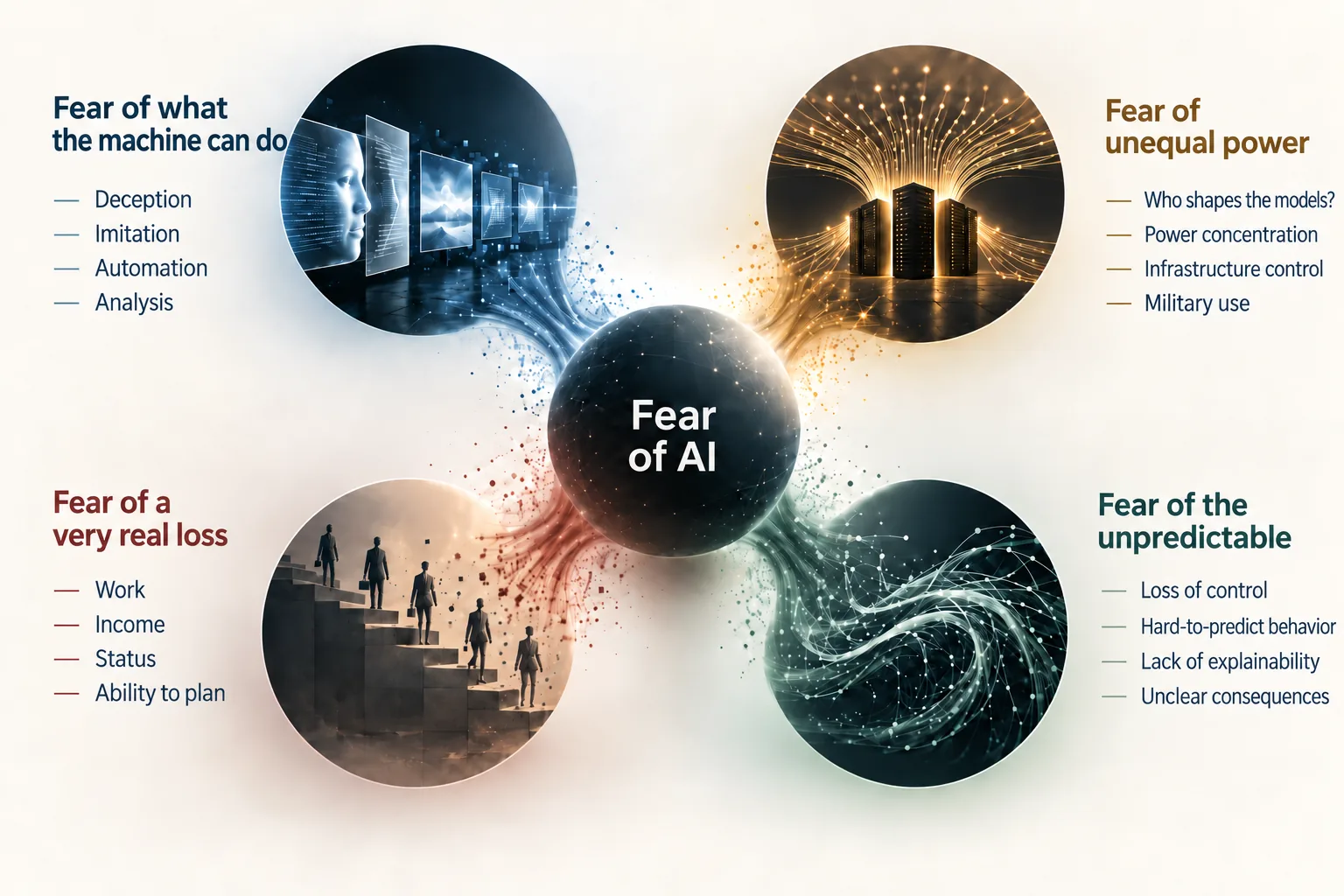
The diagnosis determines the answer
The umbrella term “fear of AI” obscures exactly these differences.
The problems are partly connected. But they do not arise from the same causes – and therefore cannot be addressed with the same tools.
Job loss cannot be solved by understanding more clearly how an AI arrives at its answers internally.
State surveillance does not disappear because an AI is trained differently.
Economic concentration of power cannot be prevented with better prompts.
And a potential loss of control over increasingly capable systems cannot be solved through social policy.
Asking whether AI is inherently “dangerous” obscures the different risks we need to address.
Related foundations
Two foundations that connect directly to this article.
THINKING WITH AI. NOT LETTING AI THINK FOR YOU.